
Raising Chicks Who Pitch In: What the Little Wise Hen Got Right About Family Life
Teaching Responsibility to Young Children: Lessons From The Little Wise Hen
I’m writing this just after watching The Little Wise Hen again with our little ones. Even though we’ve seen it many, many times, the kids always ask the same questions:
“Why didn’t the pig and the duck want to help?”
“Why do they want to eat the bread if they didn’t do any work?”
And so we talk about how it isn’t fair to want the harvest when you didn’t help with the planting. And how, just like at home, we all live here, we all make the messes, and we all take part in cleaning things up each day.
If you’ve ever read The Little Wise Hen, you probably remember the moral as something about hard work and fairness. The hen asks for help to plant, water, harvest, and bake—but the pig and duck always say “Who, me? Oh no!,” complete with a dramatic tummy ache. In the end, the hen harvests the corn alone and eats it with her chicks, leaving the pig and duck empty-handed.
The little wise hen wasn’t angry. She looked around, realized what needed to be done, and did it—with her chicks by her side. She didn’t wait for the “perfect” support system. She invited her children into the work—and together, they got it done.
That’s the part I love most! Embracing a “can do” attitude and working together as a family.
Why The Little Wise Hen Is a Great Tool for Teaching Responsibility to Young Children
In our home, when everyone pitches in—even very young children—life runs more smoothly, our kids feel empowered, and our family feels stronger as a team.
Stories like The Little Wise Hen give them something clear and simple to relate to: effort, fairness, teamwork, and the joy that comes with being part of the process.
The Rhythm of a Home That Teaches Responsibility Daily
There’s a kind of rhythm to a home. Especially a busy one with working parents, a homeschool schedule, and three young children. There are meals to prep, crumbs to sweep, waters to pour, meltdowns to soothe, and sibling quarrels that break out just after they’ve been playing perfectly well together.
It’s always easier to get things done by myself—it’s faster and more efficient. Then again, when I slow down and give my kids real, meaningful roles, I find that not only do things still get done, but my kids gain a deep sense of belonging and responsibility in the process. (It also does wonders for creating a sense of calm in the house!)
How a Two-Year-Old and a Vacuum Show Responsibility in Action
One of my favorite examples of this is our two-year-old, who has recently taken over the very important job of vacuuming the living room rug.
That rug is where our family eats dinner most nights, which means it accumulates lots of crumbs. With three small children, it gets vacuumed a couple times a day. While she’s not getting every last Cheerio or cracker crumb—she’s trying. Suddenly she’s focused, serious, purposeful. She’s watched her big sister vacuum, and this moment gives her the chance to do a “big kid” job too. And actually, she gets more than you might expect.
We still vacuum it again later (once more before bedtime), but for those few minutes, she’s an essential part of keeping the house running.
Building a Morning Routine—One Task at a Time
Every morning, our oldest child gets herself ready and then heads to the kitchen to make water cups for the whole family. She’s proud of this job—it’s hers. She gets to choose which cups go to which person, and she’s learning that small things matter. That thoughtfulness, consistency, and preparation helps the day start smoothly for everyone.
Our middle child then delivers the water cups to everyone’s seats. Her task is simple, but meaningful.
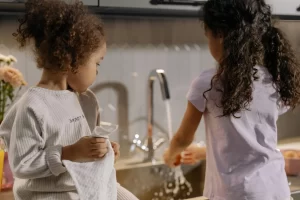
These aren’t assigned chores in a star chart or a reward system. These are just the things we do, and we each have a part. Like the wise hen and her chicks, we plant, we water, we harvest—together.
The Baby, the Big Sister, and the Best Laugh in the House
Sometimes, real life calls for quick adjustments. When something needs to come out of the oven, our youngest (still a baby) goes into his bouncer seat. And who keeps him entertained? Our two-year-old.
She’s hands down the best person in the house at making him laugh. We’ll ask her, “Can you help your baby brother while we get dinner out?” and without fail, she rushes over. She knows it’s her time to shine. She makes silly faces, sings (yells) songs, tickles him, and makes sure he’s not upset about being sat down for a few minutes.
This is a job she OWNS. In those moments, she feels like a big sister. Like one of his a caretakers.
A Well-Oiled Machine Isn’t Just Quiet—It’s Connected
People often refer to households that run smoothly as “well-oiled machines.” But I don’t think that means perfection. I think it means every part knows its purpose. Every member understands how they contribute. It means the pieces work together, even with the occasional squeak or bump.
That’s what we’re building.
We’re not aiming for spotless rooms or Instagram-worthy routines. We’re hoping to build confidence. Our kids are learning not only how to help, but why we help. They’re learning that families are built on participation.
And even when their “help” still requires us to circle back behind them, it’s worth it. Because what we’re really doing is raising children who feel vested in the life of the family. Children who know their presence and effort matter.
We’re Not Alone—We’re Together
I want to be clear: this isn’t a post about doing everything on your own.
This isn’t about pretending that outside help isn’t helpful—it often is. But sometimes, especially for working parents who homeschool, that support just isn’t available in the way we imagined.
What is available is the family right in front of us.
Instead of waiting for backup, we can look to our children. Not because we expect them to carry the load, but because they want to be part of the team. Kids don’t want to be sidelined—they want to be trusted. They want to be seen as capable.
And yes, it’s slower. And messier. And we often find that our toddler is using the vacuum to chase her sister down the hall.
Let the Story Inspire, Not Intimidate
If you want to revisit the original story with your kids, there’s a charming old video version of “The Wise Little Hen” available on YouTube (starring Donald Duck, no less!). You can watch it here for a fun little throwback. Use it as a conversation starter—ask your kids what they’d do if they were in the story. Would they help plant the wheat? Stir the batter? Slice the bread?
You might be surprised at how ready they are to help—when they’re invited into the story.
In the End, We Bake the Bread
When I think about our days—the crumb-covered rug, the mismatched water cups, the squeals of baby laughter while the oven timer dings—I think about the little wise hen, standing proudly with her chicks and a fresh loaf of bread.
She didn’t complain. She didn’t wait. She saw her family as part of the solution and moved forward.
I think that’s what we’re doing too!
We’re raising little ones who know how to contribute. Who find joy in serving. Who understand the rhythm of work and rest. Who are learning—one task at a time—that home is something we build together.
And then, in the evenings, we sit down and enjoy the bread.